Discovery
We are Byte Sized Brainz, a group of UCLA students interested in finding relationships between virtual worlds and environmental perceptions in gaming. During the COVID-19 pandemic, there was a 39% global increase in time spent video gaming (Clement, 2024). Nintendo, a popular gaming company, reported a 400% increase in profit compared to the previous year (Hackett, 2020). Animal Crossing: New Horizons emerged as the flagship title for the company during this time. It provided an escape for players to slip into an alternative reality.
Research
During the COVID-19 pandemic, where social interactions were limited and outdoor activities restricted, virtual spaces like Animal Crossing: New Horizons emerged as sanctuaries for many. As digital humanities researchers, we embarked on a journey to unravel the intricate dynamics between player demographics, environmental perceptions, and gameplay behavior within this immersive virtual world.
Our dataset, “A Multinational Dataset of Game Players’ Behaviors in a Virtual World and Environmental Perceptions” is from the Science Data Bank and founded by the Computer Network Information Center (CINC) of the Chinese Academy of Sciences. Data collection was conducted, via survey, from May 15th-30th using Google Forms in the community of Animal Crossing New Horizons players on Discord, Reddit, and Facebook platforms. In the end, 640 responses from 29 countries were received. Before this, a pilot run was done with 15 students in Japan, Singapore, United States, and Vietnam to test the questionnaire and modified based on the answers for further clarity and accuracy. Originally, our visualization software was not able to read in the CSV file, so we had to clean the data to look for errors. To solve this, we used R a (statistical software) and read through the individual data inputs. Then, we created a new data frame where each one of the original inputs were copy and pasted into a new CSV file.
The survey features 94 questions broken down into six sections: socio-demographic profile, COVID-19 concerns, environmental perceptions, game playing practice, in-game behavior, and game playing feeling. The following are examples of questions asked from each section, respectively:
- “What is your nationality?”
- “Are you currently self-isolated/social-distancing?”
- “How much do you agree with the following statements? [We are approaching the limit of the number of people the earth can support]”
- “How long have you been playing video games?”
- “How often do you do the following activities? [Catching bugs]” – “Overall, how do you feel about the game? [I felt content]”
Our dataset contained invaluable insights into the actions and interactions of players navigating their way through the game during the unprecedented times of the pandemic. We decided to focus on socio-demographic profile, environmental perceptions, and in game behavior. The central question driving our investigation was clear: “To what extent do player demographics and their personal beliefs about the environment shape their gameplay behaviors in Animal Crossing: New Horizons, particularly during the COVID-19 pandemic?”
As we prepared to delve deeper into the data, we made predictions about behaviors and expected certain patterns to emerge based on previous research on the topic. We expected players who exhibited a strong sense of environmental consciousness in their real lives to engage in behaviors aligned with sustainable practices within the game. This would include meticulously tending to their virtual gardens, planting trees, and participating in community-driven initiatives aimed at fostering a greener, more harmonious virtual world. Players who prioritized social interactions in their gameplay were expected to form tight-knit communities, organize virtual gatherings, exchange resources, and collaborate on ambitious projects that mirrored real-world collective efforts.
We hypothesized that players’ age, gender, and real-world environmental values would manifest as underlying influences in their actions within the virtual environment of ACNH. Consistent with previous research on this topic, we predicted there would be a high positive correlation between players’ traits, specifically their age, gender, and environmental values and their gameplay behavior. Despite this, we did not find strong connections in our dataset. We uncovered many nuanced connections between personal beliefs, environmental perceptions, and social dynamics within the game. As the results of data juxtaposition and visualization were non-binary, we turned to existing scholarly and literary resources to help explain our results and to discover further meaning behind the face value of simple gameplay actions like catching bugs and planting trees.
As our journey through the digital landscapes of Animal Crossing: New Horizons drew to a close, we were left with a profound appreciation for the intricate interplay between the virtual and the real. Our research underscored the transformative power of digital spaces in reflecting, shaping, and enriching our understanding of human behavior, particularly in times of uncertainty and upheaval. In unraveling the mysteries of virtual worlds, we gained invaluable insights into the complex tapestry of human technology interactions.
Methods
Based on previous research on gameplay behavior, we predicted in our dataset that player demographics and their environmental perceptions would strongly influence their gameplay behavior. The specific player demographics we focused on were 1. gender and 2. age. Because our dataset is a collection of survey responses from ACNH players around the world, the survey listed many phrases that players could rate their level of agreement with on a Likert scale ranging from 1-5 with one being “Strongly disagree” with the statement and 5 being “Strongly agree” with the statement. The specific environmental belief we chose to study was the players’ level of agreement with the statement “The Earth has plenty of natural resources if we just learn how to develop them.” The gameplay action we focused on was the players’ agreement that they frequently completed “activities involving selling fish or bugs for profit,” measured on a scale from 1-5. We then visualized their responses by comparing the two variables, 1. their gameplay action and 2. their environmental perception. Our visualizations were then broken down further by either 1. gender or 2. split into different age ranges. We did this by splitting the original dataset into extra, smaller datasets that met the previous conditions. To operationalize and calculate a “strong influence,” after creating each visualization, we calculated the R value between each pair of variables to see how strongly correlated they are.
An important distinguishing feature to point out is that some of the variables we are looking at are more fixed characteristics of the players’ identity, specifically the demographic traits of gender and age, while the other is a personal belief they had about the environment that the players only expressed during that set time they took the survey. Therefore, their environmental beliefs can be subject to change, while one cannot just change their gender or age right after taking the survey. This difference between demographic traits vs personal beliefs did end up impacting our results, as our visualizations did not show any correlation until we broke down the graphs further by gender and age. After we separated a visualization by gender and age, we saw higher correlations between the variables. Although these correlations were still not very robust, it is worth noting and could speak to the complex relationship between player demographics and gameplay behavior.
Data

Density-Colored Scatter Plot of E12 vs. C6: Density-Colored Scatter Plot Comparing Frequency of Activities Involving Seeking Fish or Bugs for Profit and Level of Agreement with the Statement “the Earth has plenty of natural resources if we learn how to develop them”
- Variable 1 (X axis): E12 → frequency of activities involving seeking fish or bugs for profit
- Variable 2 (Y axis): C6 → level of agreement with the statement that the Earth has plenty of natural resources if we learn how to develop them
- correlation: -0.007537497 (no relation)
- Split 1: by gender
- For males: -0.1124666
- For females: 0.0426888
- Split 2: by age
- Age 11-18: 0.1513015
- Age 19-26: -0.009226781
- Age 27-34: -0.02879929
- Age 35-42: 0.04488948
- Age 43-55: 0.03194383
- Split 1: by gender
The correlation between the two statements is -0.007537497. This correlation coefficient is very close to zero, suggesting that there is no linear relationship between how often individuals engage in activities of selling fish or bugs for profit and their belief that Earth has abundance of natural resources when properly developed. This implies that perceptions on the environment do not influence in-game action regarding the frequency of commercial activities involving fish or bugs.
However, when grouping this data by gender and age differences, we found higher correlation coefficients. As mentioned earlier, some of the traits we focused on are fixed characteristics of the players’ identity, specifically demographic traits like age and gender, while the other is a personal belief on environmental impact that the players expressed during that set time they took the survey. Although none of the R values suggested a strong correlation, this difference between demographic traits vs environmental beliefs did make a change in our results, as those demographic traits that are more fixed characteristics of their identity, namely their age and gender, resulted in slightly stronger correlations between E12 and C6 than the correlations that were not broken down by age and gender.

Male: Density-Colored Scatter Plot of E12 vs. E6: Density-Colored Scatter Plot Comparing Frequency of Activities Involving Seeking Fish or Bugs for Profit and Level of Agreement with the Statement “the Earth has plenty of natural resources if we learn how to develop them” Broken Down by Male Respondents
- Variable 1 (X axis): male: E12 → frequency of activities involving seeking fish or bugs for profit
- Variable 2 (Y axis):male: C6 → level of agreement with the statement that the Earth has plenty of natural resources if we learn how to develop them
- correlation: -0.1124666
The correlation between the two statements is -0.1124666 for males. This correlation coefficient is very close to zero but is slightly negative. As the frequency of selling fish/bugs for profit (E12) increases, the level of agreement with the idea that the Earth has abundant natural resources if properly developed (C6) decreases, and vice versa. However, this correlation is also very close to zero. This implies that perceptions on the environment do not influence in-game action regarding the frequency of commercial activities involving fish or bugs.
- Variable 1 (X axis): female: E12→ frequency of activities involving seeking fish or bugs for profit
- Variable 2 (Y axis): female: C6→ level of agreement with the statement that the Earth has plenty of natural resources if we learn how to develop them
- Correlation: 0.0426888

Female: Density-Colored Scatter Plot of E12 vs. E6 Density-Colored Scatter Plot Comparing Frequency of Activities Involving Seeking Fish or Bugs for Profit and Level of Agreement with the Statement “the Earth has plenty of natural resources if we learn how to develop them” Broken Down by Female Respondents
The correlation between the two statements is 0.0426888 for females. This correlation coefficient is very close to zero, suggesting that there is no linear relationship between how often individuals engage in activities of selling fish or bugs for profit and their belief that Earth has abundance of natural resources when properly developed. This implies that perceptions on the environment do not influence in-game action regarding the frequency of commercial activities involving fish or bugs.
- Variable 1 Ages 11-18: E12→ frequency of activities involving seeking fish or bugs for profit
- Variable 2 (Y axis):Ages 11-18: C6→ level of agreement with the statement that the Earth has plenty of natural resources if we learn how to develop them
- correlation: 0.1513015

Ages 11 to 18: Density-Colored Scatter Plot of E12 vs. E6: Density-Colored Scatter Plot Comparing Frequency of Activities Involving Seeking Fish or Bugs for Profit and Level of Agreement with the Statement “the Earth has plenty of natural resources if we learn how to develop them” Broken Down into Age Ranges
The correlation between the two statements, with E12 (frequency of activities involving selling fish or bugs for profit) and C6 (level of agreement with the statement that the Earth has plenty of natural resources if we learn how to develop them) is 0.1513015 for players ages 11-18. As the frequency of engaging in selling fish or bugs for profit increases, there is a slight tendency for the level of agreement that the Earth has abundant natural resources if properly developed to also increase. It is still close to 0, suggesting a weak correlation.
ACNH Map
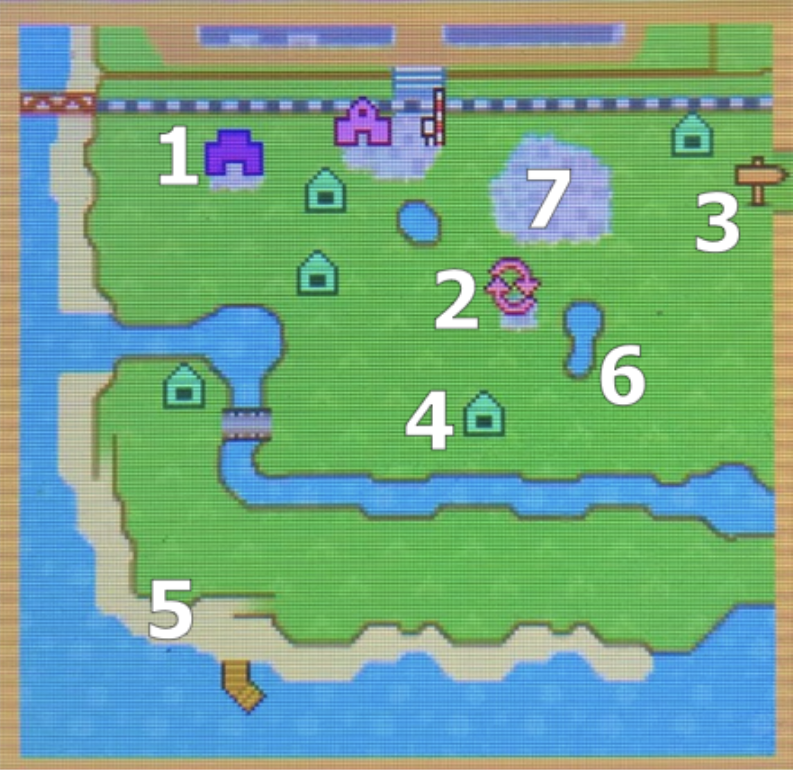
As a new player, a person can choose from five different base maps that have various arrangements of the same, key locations. The map we chose to display is entitled, “Straight and Narrow.” Beyond the start of a game, a player can terraform their map as they please. So, this map is meant to introduce the tutorial locations and objects not added by the player.
- The Town Hall is where you perform all your mayoral duties. This is where you decide to place homes for citizens, choose who moves in and out of your island, and begin “Public Works Projects,” which are player added facilities that improve island quality.
- The Retail store is a place for the player to purchase additional tools and items needed for foraging, collecting, and crafting.
- The Campsite is the only Public Works Project that is not added by the player and it cannot be destroyed. This is where new villagers will come to visit your island and you may discuss full-time residency with them.
- This is an example of a villager’s home.
- The beach is where you can fish, collect butterflies and other bugs, and dig up treasure that is unique to that biome.
- The pond is similar to the beach, but also has unique things to collect and harvest as an independent biome.
- The Plaza is where players can begin multiplayer activities. Players can be summoned into one another’s islands from this location.
Conclusion
Although we did not find strong correlations between the variables we compared, the relationship between demographic and personal beliefs of players and their gameplay behavior is an exciting new area of research. We chose to research gameplay behavior because video games have never been so widespread. Just in the US, over 150 million people play video games for at least 3 hours a week (Nichols, 2023). Despite this, video game research is not growing at the same speed that the video game industry is growing. By creating this project, we aim to help video game designers, environmental policymakers, or human technology interaction (HTI) researchers understand the strong relation between player demographics and personal beliefs about the environment and their in-game behavior. Because video games have never been more popular and accessible for all types of users, the interaction between human player characteristics and virtual behavior is a relationship that is becoming increasingly important to study. As environmental concerns are spiking dramatically, understanding this relationship can help video game makers design games that can have two impacts: to both teach and galvanize players to tackle real-world problems, like human environmental impact, while simultaneously offering players a comforting virtual land to escape to.
To expand on this first impact, as previously mentioned, there is a complex relationship between in-game behaviors and real-world actions (Rubin, 2021). In addition to the data presented in our project, we hope future research will dive into the psychological processes of how humans can learn from virtual experiences. From here, video games can then be designed with the intention to allow players the space to learn from their experiences in these games and apply the skills they gained to real-world problems. One study suggested that in regard to experience-based learning in video games, game designers should include factors like 1. scaffolding methods, a psychological concept for facilitated learning, in their game design 2. feedback on player learning rather than player performance and 3. include set times for players to reflect on their learning processes, even if this disrupts game time (Westera, 2019). In regard to motivating players, game designers should 1. minimize styling elements that demand a high cognitive load from the players 2. increase player freedom and responsibility in the game to give them a sense of autonomy and 3. offer scenarios that are challenging but doable to increase player competency (Westera, 2019). Hopefully when designing with intention, video games can both teach and inspire their players to use the skills and behaviors they developed in these video games and apply them to real-world problems.
To expand on the second impact, historically virtual worlds (like Massive Multiplayer Role Playing Games) arose in the early 2000s and became homes for the outcasts of society. They were often virtual spaces that provided a sense of anonymity and confidence that players could not get in the real world, and were generally created by outcasts themselves. For example, players could log on and start a new life as a dragon slayer or the hottest celebrity. In the 2010s, many of these online servers began to shut down because their original purpose had been lost after being sold to various corporations. But profit was never really the goal in creating these virtual spaces and they became money sinks. This resulted in the destruction of hundreds of online communities that provided mental and social solace for millions of people across the globe.
Furthermore, environmental perceptions and personal beliefs relate to the fulfillment or deprivation of individual needs, which include both psychological desires and physiological necessities. These significantly impact one’s worldview, attitudes, and values, shaping their perception of themselves, others, and the environment around them. By experiencing gameplay situations, individuals may find satisfaction for various needs, impacting their attitudes and behavior within the game world and the broader reality around them. In a comparative analysis of Animal Crossing: New Horizons and Maslow’s hierarchy of needs (a psychological theory suggesting that human needs can be arranged in a hierarchy), Benti and Stadtmann examine how gameplay in ACNH satisfies various human needs for both players through virtual characters (2021). According to this study, there are two main types of satisfied needs in the game: deficiency-motivated and growth-motivated needs. The former includes considerations like food and safety, which are met by fostering feelings of connection and addressing loneliness through virtual activities. As players set goals, accomplish tasks, and receive recognition, they fulfill esteem needs. On the other hand, the latter relates to aesthetic expression through customization of a virtual environment and cognitive learning born from in-game task participation and relationships with others in a virtual world (Benti and Stadtmann, 2021). This particular group of needs demonstrates the complex and significant relationship between virtual experiences and perceptions of reality. This analysis confirms the clear, mutually effective relationship between human psychology and gameplay behavior.
These days the gaming experience is much more personal as companies market games that focus on individual play. However, during the pandemic, games like Among Us and ANCH were extremely sought after specifically for their multiplayer capabilities. In the era of meta verse death, people were in dire need of a new communal space that served as both entertainment and a social outlet. This type of “escapism” is common behavior for those experiencing trauma. In this case, the global nature of such trauma warrants a shared space to communicate internal conflicts and reflect.
Moreover, the therapeutic aspects of ANCH continue to be utilized today. People will host counseling sessions, celebrate holiday events, and even form bonds that can grow into the real world. Forgetting the burdens of real life to enter this virtual world of your own design is incredibly liberating and is the foundation for what makes the game so popular. The pacifying atmosphere of nature and a simple lifestyle also contrast much of what the average American experiences in traditional urban life. ANCH has gone above and beyond in providing people with joy during trying times. Our team hopes that our investigation of the game’s impact can offer an exciting future for game designers while also perpetuating a standard of community development in the gaming industry and deepen the appreciation for the intentional artistry of video games.